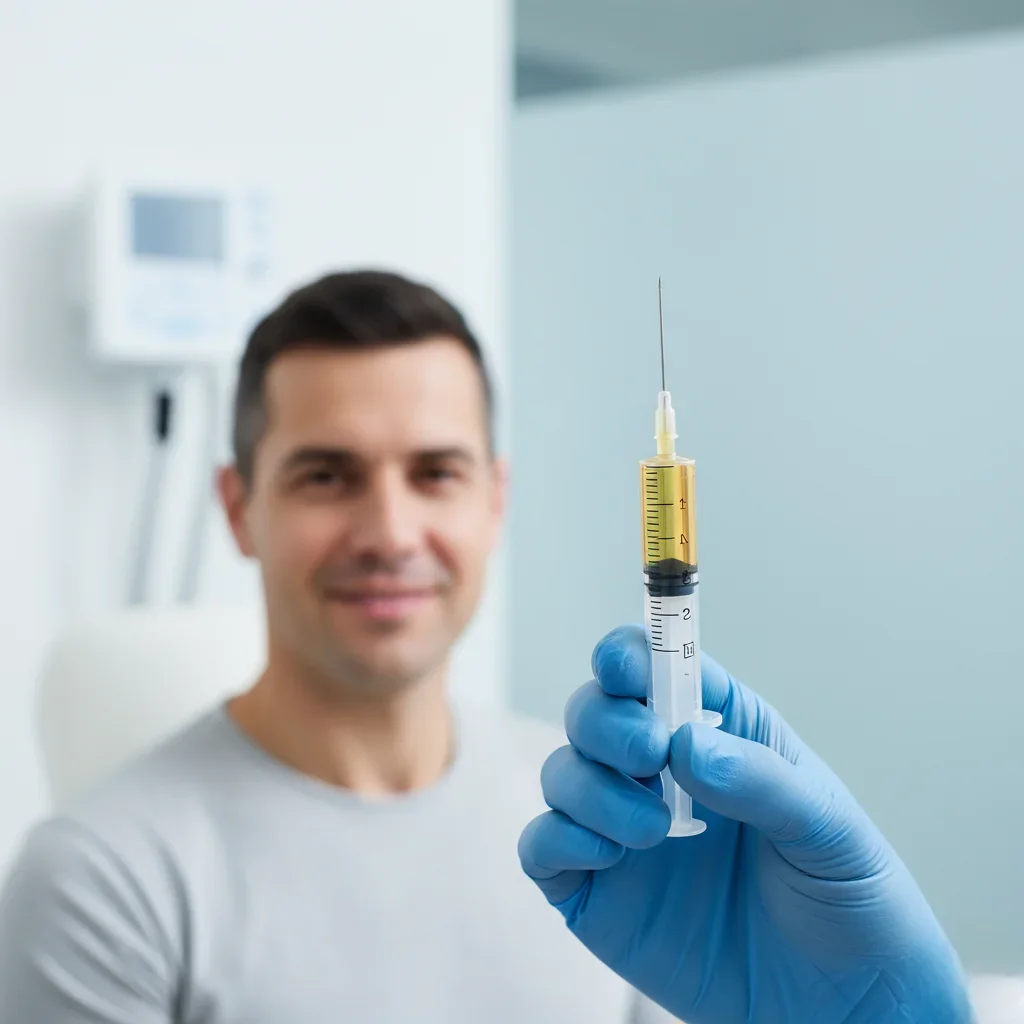
Erectile dysfunction, Peyronie's disease, and reduced sexual performance often have a cellular cause: blood vessels that no longer respond, nerve endings that have lost sensitivity, and collagen that has weakened with age. Oral medications push blood toward tissue that may no longer hold it, while the Priapus Shot uses platelet-rich plasma drawn from your own blood to support the structure underneath. This guide explains what the P-Shot is, who is a candidate, how the procedure works, the benefits and the real risks, how it compares to pills, and what treatment involves.
Most men who notice softer erections, less sensitivity, or curvature assume the cause is purely in the bloodstream or in their head. More often the real issue lives in the tissue itself, which is exactly where PRP works. This guide explains what the Priapus Shot is, who is a candidate, how the procedure works, its benefits and risks, how it compares to oral medication, and what treatment involves, so you can decide whether a regenerative approach fits your goals.
What Is the Priapus Shot (P-Shot)?
Answer: The Priapus Shot is a nonsurgical, in-office procedure that uses platelet-rich plasma (PRP) drawn from your own blood, then injected into specific areas of the penis to support healthier tissue, circulation, and sensitivity.
PRP is concentrated from a small blood sample using a centrifuge that separates the platelets and growth factors your body naturally uses to repair itself. Mayo Clinic describes how platelet-rich plasma concentrates these healing growth factors from a patient's own blood. Because the material comes from you, there is no synthetic drug and no donor product involved. Once prepared, the PRP is injected by a trained provider after the area is numbed for comfort, signaling local tissue to regenerate.
How Does the Priapus Shot Work?
Answer: The P-Shot works by delivering concentrated platelet growth factors into penile tissue, where they signal new blood vessel formation, nerve support, and collagen repair, improving circulation and sensitivity gradually over several weeks.
Your visit begins with a simple blood draw, much like a routine lab test. The sample is spun in a centrifuge to isolate the platelet-rich layer, which is prepared fresh and injected into precise areas after a topical numbing agent is applied. Because the goal is gradual tissue regeneration rather than an immediate chemical effect, results develop over time as your body responds, which is why many men pursue the P-Shot when oral medications have stopped working as well as they once did.
Who Is a Candidate for the P-Shot?
Answer: Good candidates are men with mild to moderate erectile dysfunction, reduced sensitivity, or early Peyronie's disease who want a regenerative option, ideally confirmed after a review of hormone levels and vascular health.
Erectile dysfunction is common and has many overlapping causes, from vascular and neurological to hormonal and psychological, as the National Institute of Diabetes and Digestive and Kidney Diseases explains in its overview of erectile dysfunction. Because the cause matters, our providers review your history and labs before recommending the P-Shot, so the treatment fits the actual problem rather than a generic script. Men with severe vascular disease or certain blood disorders may be better served by other options, which is part of why candidacy is assessed individually.
What Are the Benefits of the Priapus Shot?
Answer: Reported benefits include firmer and more reliable erections, improved sensitivity, and, for some men, reduced curvature from Peyronie's disease, with improvements building gradually rather than depending on a pill before activity.
Because the P-Shot targets the underlying tissue, the goal is durable change rather than a temporary effect that fades when a medication clears. Some men also find they rely less on oral medication afterward. It is worth noting that PRP for sexual function is still an emerging area of regenerative medicine, and individual response varies, which is why a provider sets realistic expectations before you begin.
P-Shot and Peyronie's Disease
Answer: For Peyronie's disease, the P-Shot uses platelet growth factors to support remodeling of the scar tissue and plaque that cause penile curvature and painful erections.
Peyronie's disease develops when fibrous scar tissue forms inside the penis, often after minor injury, leading to a bend, indentation, or discomfort. The regenerative aim of the P-Shot is to encourage healthier tissue in that area. Men with Peyronie's disease frequently see better results when PRP is paired with a coordinated, physician-guided plan rather than a single one-off injection, since the condition responds to consistent care over time.
What Are the Side Effects and Risks?
Answer: Most side effects are mild and local, such as temporary bruising, swelling, redness, or tenderness at the injection site; because the PRP comes from your own blood, serious reactions are uncommon.
Some men feel brief pressure or mild discomfort during the injection, and minor soreness can last a day or two afterward. Since the platelet-rich plasma is autologous, meaning it is derived from your own body, there is no risk of an allergic reaction to a foreign drug. As with any injection there is a small risk of infection or bleeding, which is minimized when the procedure is performed under proper medical supervision. A provider reviews your individual risks before treatment.
How Does the P-Shot Compare to ED Pills?
Answer: Oral ED pills relax smooth muscle to boost blood flow temporarily and must be taken before activity, while the P-Shot aims to regenerate the underlying tissue so improvements develop gradually and are not tied to a dose.
The two approaches work in fundamentally different ways, and for some men they complement each other. The table below summarizes the practical differences.
| Approach | How it works | Timing of effect | Often suits |
|---|---|---|---|
| Oral ED medication | Relaxes smooth muscle to increase blood flow on demand | Active for hours after each dose | Men who want immediate, as-needed support |
| Priapus Shot (PRP) | Delivers growth factors that regenerate vascular and nerve tissue | Builds over four to eight weeks | Men seeking a longer-term, biology-based approach |
| Combined plan | Regenerative PRP with oral support during the early phase | Immediate plus gradual | Men bridging short-term needs with lasting change |
Many men reduce their reliance on oral medication after the P-Shot, but the right combination depends on your goals and how your body responds. A provider helps you weigh the trade-offs.
How Often Are P-Shot Treatments Needed?
Answer: Many patients notice improvement after one to two treatments, with results developing over four to eight weeks per session, and maintenance injections every 12 to 18 months are common to sustain results.
Because the P-Shot relies on your body's own regenerative response, the timeline is individual. Some men reach their goals with a single session, while others benefit from a short series. Maintenance keeps the gains from fading over time, and your provider builds a schedule around how you respond rather than a fixed formula.
How Much Does the Priapus Shot Cost?
Answer: The Priapus Shot is a regenerative procedure and is generally not covered by standard health insurance, so it is typically self-pay, with cost varying by the number of sessions and any combined therapies.
Because plans are individual, our team reviews the full cost and any financing options at your consultation before you commit, so there are no surprises. The goal is a plan you can sustain, since regenerative results are supported over time rather than fixed in a single visit.
Why Choose AgeRejuvenation for the Priapus Shot?
Answer: Every P-Shot at AgeRejuvenation is physician-guided rather than delegated to an assembly-line process, with candidacy, expectations, and follow-up handled by providers who treat sexual performance as a signal, not just a symptom.
We approach men's health by looking at the whole picture, since sexual function connects to circulation, hormones, sleep, stress, and metabolic health. When labs reveal a hormonal component, your provider may discuss optimizing testosterone alongside regenerative care, and when the issue is primarily vascular, we focus there. As a functional-medicine and longevity practice, we coordinate the P-Shot with your broader wellness so improvements are reinforced by your overall health. The Priapus Shot anchors our physician-guided men's health care, which also addresses erectile dysfunction, hormone optimization, and acoustic wave therapy. If you want a root-cause look at performance and confidence, our team can help you decide whether this regenerative approach is right for you.
Explore more in our men's health physician services .