Fine lines that started as suggestions are now features. Sun spots from years of outdoor living have settled in. Acne scars you assumed would fade have not. Topical creams smooth the surface but cannot reach the deeper structure where this damage lives. CoolPeel can. It uses a fractional CO2 laser to remove the damaged outer skin and stimulate fresh collagen underneath, improving texture, tone, and scarring in a clinical setting without the long recovery of older resurfacing lasers.
This guide explains CoolPeel CO2 laser resurfacing in plain terms: what it is, the skin concerns it addresses, who is a good candidate, how the session feels, the downtime to expect, how it compares to traditional resurfacing, and what it costs. Topical products can smooth the surface, but they cannot reach the deeper structure where photoaging and scarring live. CoolPeel works at that deeper layer to refresh texture, tone, and firmness.
What Is CoolPeel Laser Treatment?
Answer: CoolPeel is a fractional CO2 laser treatment that removes the damaged outer layer of skin while triggering new collagen in the dermis beneath, improving fine lines, sun damage, and acne scars with minimal downtime.
The laser ablates the top layer of the epidermis to clear accumulated photodamage, discoloration, and dead surface cells, then the controlled heat stimulates collagen remodeling that continues for weeks afterward. That remodeling is why results keep improving over time. CoolPeel is delivered by board-certified medical providers in a clinical setting, not an aesthetician suite, which matters for both safety and consistency. A clinical review in the Journal of Clinical and Aesthetic Dermatology found that fractional CO2 lasers consistently improve acne scarring, photoaging, and skin texture with favorable safety profiles.
How Does CoolPeel Differ From Traditional CO2 Resurfacing?
Answer: CoolPeel uses high peak power with very short pulses, so it ablates target tissue before heat spreads to surrounding skin. That precision is what cuts the recovery from one to two weeks down to a few days.
Older full-ablation CO2 resurfacing creates a deep wound that takes roughly 7 to 14 days to heal. CoolPeel limits thermal spread, producing effective resurfacing with a recovery window most patients describe as 3 to 5 days of redness and light peeling. You still get the collagen benefit of a CO2 laser without trading away nearly two weeks of social downtime.
What Skin Concerns Does CoolPeel Treat?
Answer: CoolPeel treats fine lines and wrinkles, acne scars, sun spots and uneven tone, enlarged pores, and rough texture by resurfacing the surface and rebuilding collagen underneath.
Shallow to moderate acne scars respond well, since ablating the upper dermis reduces their visible depth and surface irregularity. Fine lines soften gradually as new collagen integrates, especially around the eyes and mouth, with results developing over 3 to 6 months. The same controlled injury narrows the look of large pores and smooths overall texture. Cleveland Clinic notes that carbon dioxide lasers precisely remove thin layers of skin to treat sun damage, wrinkles, and scars. For the wider range of texture, tone, and rejuvenation options, our medical spa and aesthetic care reviews which approach fits your skin.
Who Is a Good Candidate for CoolPeel?
Answer: Good candidates have visible photoaging, fine lines, or shallow-to-moderate acne scars and can plan for a few days of redness. Skin type and Fitzpatrick classification guide protocol selection more than age alone.
Most patients who see the strongest improvement fall between 30 and 60, but the deciding factors are your skin type, history, and goals, not a birthday. Darker skin tones require careful settings to reduce the risk of pigment changes, which is one reason a provider assesses your Fitzpatrick score before treating. Active infections, certain skin conditions, recent isotretinoin use, and pregnancy are reasons to delay or avoid treatment, and your provider screens for these at consultation. The American Academy of Dermatology outlines the skin conditions that laser treatments can and cannot address, which helps set honest expectations.
What Are the Benefits of CoolPeel?
Answer: CoolPeel improves tone and texture from a single modality, stimulates lasting collagen, and delivers all of it in a short session with only a few days of recovery.
Because the laser both clears surface damage and rebuilds collagen, you address discoloration and sun spots alongside scarring, pore size, and fine lines in one treatment rather than stacking separate procedures. The session itself runs about 15 to 20 minutes for the face, which makes it practical for busy schedules. As Mayo Clinic explains regarding what laser resurfacing treats and how recovery works, the improvement builds as the skin heals and new collagen matures, so the result you see at one week is not the final result.
Is CoolPeel Painful, and What Does the Session Feel Like?
Answer: Most patients describe mild warmth or brief stinging rather than pain. A topical numbing cream is applied beforehand, and CoolPeel was engineered for comfort as well as efficacy.
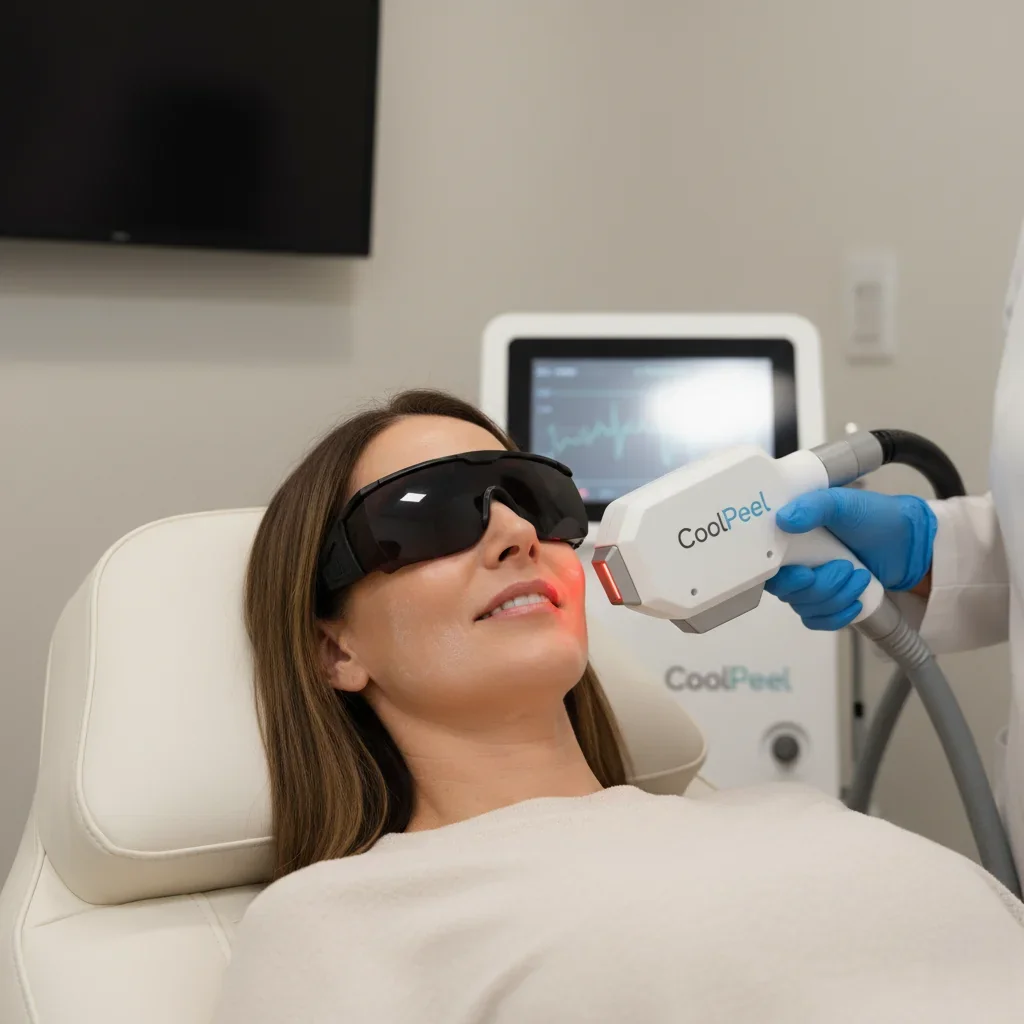
Before treatment, your provider cleanses the skin and applies a numbing agent so the laser passes feel like warmth more than discomfort. The handpiece moves across the treatment area in measured passes, and the whole face typically takes 15 to 20 minutes. Afterward the skin feels warm and looks flushed, similar to a moderate sunburn, which settles over the following days.
What Is Recovery and Aftercare Like?
Answer: Expect 3 to 5 days of redness and light flaking as the resurfaced skin sheds and renews. Gentle cleansing, frequent moisturizing, and strict daily sunscreen protect the result while collagen rebuilds.
In the first days the skin may feel tight and look pink, then it begins to flake lightly as fresh skin surfaces. Avoid picking, harsh actives, and direct sun during this window. Diligent sun protection is not optional, because newly resurfaced skin is more vulnerable to pigment changes and because UV exposure is what drives much of the photoaging in the first place. Your provider gives you a specific aftercare plan matched to your skin and the number of passes performed.
How Many CoolPeel Sessions Will I Need?
Answer: Many patients see visible improvement after a single CoolPeel session. Moderate to significant scarring or photoaging often benefits from 2 to 3 sessions spaced 4 to 6 weeks apart.
One treatment is enough for a meaningful refresh in milder cases, while deeper scarring and heavier sun damage respond best to a short series that lets collagen build in stages. Spacing sessions several weeks apart gives the skin time to heal fully between treatments. Your provider sets the plan after assessing your skin, rather than applying a fixed package to everyone.
CoolPeel vs. Other Resurfacing Options
Answer: CoolPeel is a fractional CO2 laser tuned for collagen stimulation with short downtime. Traditional CO2 resurfacing is more aggressive with longer recovery, while non-laser options like microneedling and chemical peels work at shallower depths.
Each resurfacing approach trades depth of correction against recovery time, so the right choice depends on your concern, your skin type, and how much downtime you can plan for. The table below compares common options on the factors patients ask about most.
| Option | How it works | Typical downtime | Often suits |
|---|---|---|---|
| CoolPeel (fractional CO2) | Short high-power pulses ablate surface skin and stimulate collagen | About 3-5 days | Fine lines, sun damage, shallow-to-moderate acne scars with limited downtime |
| Traditional CO2 resurfacing | Full ablation of the outer skin in a single deep treatment | About 7-14 days | Deeper wrinkles or scarring where stronger correction is acceptable |
| Microneedling | Fine needles create micro-channels to prompt collagen | About 1-2 days | Mild texture and early fine lines with very little downtime |
| Chemical peel | Acid solution exfoliates the outer skin layers | Varies by depth | Surface tone, mild discoloration, and uneven texture |
A provider can recommend one approach or a coordinated combination after assessing your skin, and the right plan can change as your skin responds.
How Much Does CoolPeel Cost?
Answer: CoolPeel is an elective cosmetic treatment, so it is generally self-pay and not covered by insurance. The total depends on the area treated, the number of passes, and how many sessions your plan calls for.
Because pricing is individual, your provider reviews the full cost during consultation so there are no surprises before you book. If a series is recommended, you will know the per-session and total investment up front, along with what to expect at each stage.
Why Choose AgeRejuvenation for CoolPeel?
Answer: CoolPeel done well is individualized, which a one-size protocol cannot deliver. Our providers calibrate the laser to your skin type, Fitzpatrick classification, history, and goals.
We do not treat every skin concern with the same settings. Before recommending CoolPeel, a provider reviews your skin and goals, then tailors the session and aftercare to you. CoolPeel is one of several skin resurfacing and rejuvenation treatments we offer, and for patients with volume loss alongside texture concerns, your provider can discuss whether pairing resurfacing with other options fits your goals. Ready to reclaim visible, healthier skin? Schedule a consultation with AgeRejuvenation today.
Explore more in our medical spa services .