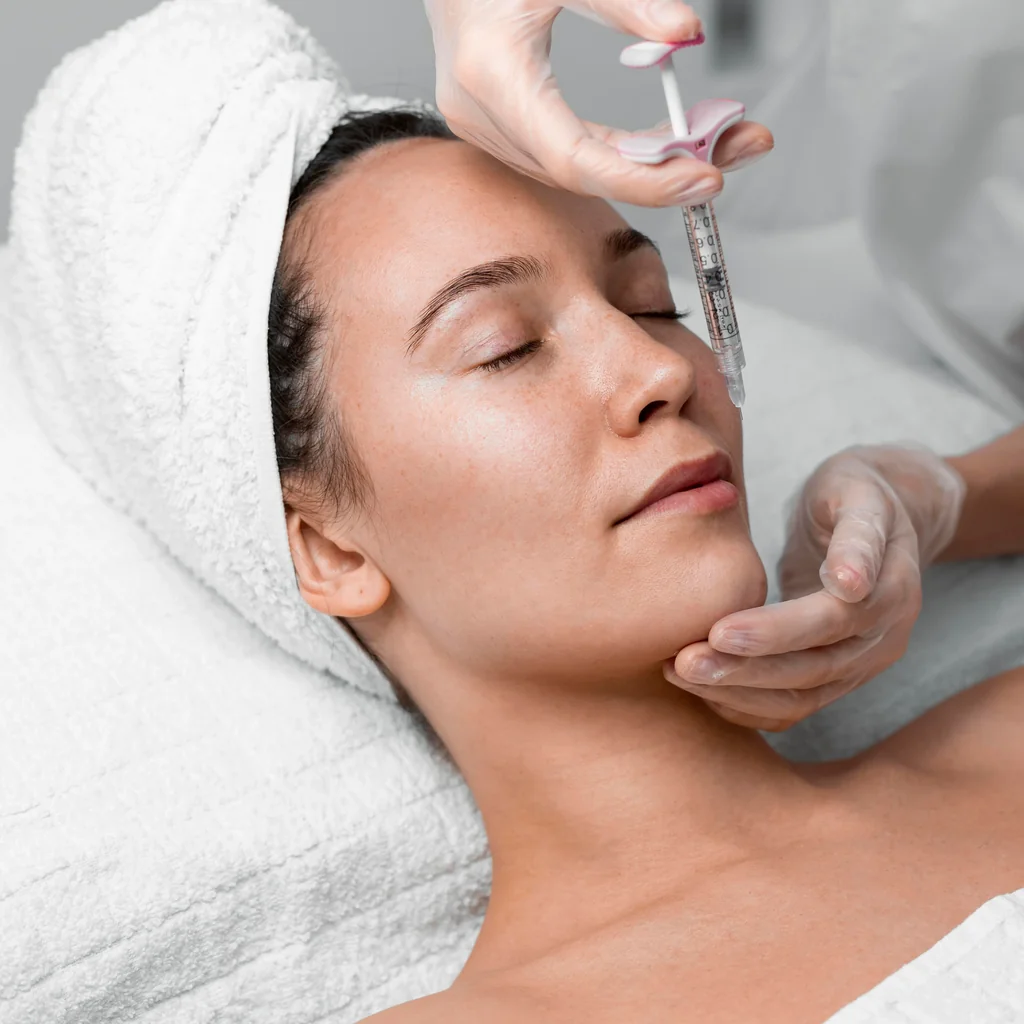
Volume loss is the part of facial aging that creams cannot fix. Moisturizers address the surface and sunscreen prevents further damage, but neither restores the structure that has shifted downward and inward over the years. Dermal fillers replace what has been lost, using hyaluronic acid, a compound your skin already produces, placed at precise depths to lift soft tissue, define contours, and smooth wrinkles from the inside out. When the work is done by trained medical injectors, the result reads as you at your best, not as someone who had work done.
Dermal fillers replace the facial volume that quietly disappears with age, restoring structure that creams and serums simply cannot reach. This guide explains what dermal fillers are, the most common types, who makes a good candidate, how treatment works, how long results last, the real benefits and risks, what fillers cost, and how they compare with other ways to address lines and volume loss.
What Are Dermal Fillers?
Answer: Dermal fillers are injectable gels, most often made of hyaluronic acid, placed beneath the skin to restore facial volume, soften lines and wrinkles, and enhance features like the lips and cheeks.
Hyaluronic acid (HA) is a sugar molecule your skin already produces to hold water and stay plump, which is why HA-based fillers are biocompatible and well tolerated. Because the gel adds volume directly, results are usually visible from the first session, and Cleveland Clinic describes how hyaluronic acid fillers add volume and smooth wrinkles across areas like the cheeks, lips, and folds around the mouth. At AgeRejuvenation, every filler treatment is performed by trained medical providers who tailor the placement to your anatomy rather than following a one-size template.
What Areas and Concerns Do Dermal Fillers Treat?
Answer: Dermal fillers commonly treat mid-face and cheek volume loss, nasolabial folds, marionette lines, thin or asymmetric lips, under-eye hollows, and chin or jawline definition, with placement chosen for each concern.
The mid-face is often the first place volume loss shows, as cheeks flatten and the folds running from the nose to the mouth deepen. Fillers can also raise the floor of shallow, depressed acne scars to match the surrounding skin, and they can balance subtle facial asymmetry by adding volume to the less prominent side. Very superficial fine lines and skin texture usually respond better to resurfacing rather than filler, which is a distinction your provider will make during the consultation.
Who Is a Good Candidate for Dermal Fillers?
Answer: Good candidates are generally healthy adults bothered by volume loss, folds, or thin lips who have realistic goals. People with an active skin infection at the site, certain clotting disorders, or relevant allergies should be evaluated first.
Pregnancy and breastfeeding are typically reasons to wait, and blood thinners or supplements that thin the blood can increase bruising, so disclose everything you take. The honest screen matters more than the injection itself, because the right candidate, the right product, and the right amount are what produce a natural result. A consultation reviews your health history, your goals, and your facial structure before anything is placed.
How Does a Dermal Filler Treatment Work?
Answer: After a consultation and mapping of your face, the provider cleanses the area, often uses a numbing agent, and injects small amounts of filler at precise depths, shaping as they go. Most visits take roughly fifteen to forty-five minutes.
Many HA fillers include lidocaine to keep the appointment comfortable, and the provider may massage the area to smooth the result. You will usually see the change before you leave. Mild swelling over the first day or two can slightly affect the look, which settles within about a week as the filler integrates with your tissue.
Are Dermal Fillers Safe?
Answer: Dermal fillers have a strong safety record when placed by trained medical injectors. Bruising and mild swelling are the most common effects, while serious complications are rare and are most often tied to injection technique and facial anatomy.
The single biggest safety factor is who holds the syringe. Filler injection is a medical procedure, and the American Academy of Dermatology offers dermatologists' guidance on choosing a qualified filler injector rather than a non-medical setting like a salon or a filler party. A systematic review on the safety and satisfaction of HA fillers found these products are generally safe with high patient-satisfaction value, while noting that rare serious events such as vascular occlusion underscore why anatomy and training matter. At AgeRejuvenation, trained medical providers perform every treatment.
What Are the Side Effects and Risks of Dermal Fillers?
Answer: The most common side effects are temporary redness, swelling, bruising, and tenderness at the injection site. Less common issues include lumps, asymmetry, and, rarely, infection or vascular complications that require prompt medical attention.
Most reactions resolve on their own within days. Lumps or unevenness can often be smoothed or adjusted, and because HA fillers are dissolvable, an unwanted result can be corrected. The rare but serious risk is filler entering a blood vessel, which is exactly why injector training, knowledge of facial anatomy, and a medical setting are non-negotiable. Reporting unusual pain, skin color changes, or vision changes right away allows quick treatment.
How Long Do Dermal Filler Results Last?
Answer: Most hyaluronic acid filler results last about six to twelve months, and some longer-lasting products extend beyond a year. Lips and other high-movement areas metabolize filler faster than the cheeks or jawline.
Longevity depends on the product, the area treated, the amount placed, and your individual metabolism. Maintenance touch-ups before the filler fully fades tend to keep results looking consistent and often require less product over time. Your provider can map out a realistic timeline at your first visit.
Are Dermal Fillers Reversible?
Answer: Hyaluronic acid fillers are reversible. An enzyme called hyaluronidase breaks the filler down, which can correct an unwanted result, adjust placement, or resolve a complication.
This reversibility is a meaningful safety advantage and a reason HA is the most common filler material in aesthetic medicine. Semi-permanent and permanent fillers, such as those based on calcium hydroxylapatite or poly-L-lactic acid, are not dissolvable in the same way, so they call for an even more conservative, experienced approach.
How Do Dermal Fillers Compare With Other Wrinkle Treatments?
Answer: Fillers add volume to fill creases and plump features, neuromodulators relax the muscles that cause expression lines, and resurfacing treatments smooth surface texture. Many faces benefit from a combination rather than a single tool.
| Concern | Best-suited approach | What it does | Typical duration |
|---|---|---|---|
| Volume loss, folds, thin lips | Hyaluronic acid filler | Replaces lost volume and lifts soft tissue | About 6 to 12 months |
| Frown lines, crow's feet from movement | Neuromodulator (muscle relaxer) | Relaxes the muscles that crease the skin | Roughly 3 to 4 months |
| Surface texture, fine lines, tone | Resurfacing or microneedling | Smooths and renews the skin surface | Builds over weeks, varies |
| Deep, depressed acne scars | Filler under the scar base | Raises the scar floor to the skin level | About 6 to 12 months |
Filler does not treat every line equally, and it is not a substitute for muscle relaxers or resurfacing. The most natural outcomes usually come from matching each concern to the treatment built for it, which a consultation sorts out.
How Much Do Dermal Fillers Cost?
Answer: Dermal filler pricing is typically self-pay and usually quoted per syringe, so the total depends on the product chosen, how many syringes your goals require, and the areas being treated.
Because filler is a cosmetic treatment, it generally falls outside insurance coverage. The right number of syringes is the amount that achieves a balanced, natural result, not the most product possible. We review the full plan and cost with you before treatment so there are no surprises, and a maintenance plan can spread the investment over time.
Why Choose AgeRejuvenation for Dermal Fillers?
Answer: AgeRejuvenation treats filler as facial artistry grounded in medical training, with trained providers, an individualized consultation, and placement that honors your existing features rather than a default protocol.
Our providers combine advanced injection technique with a careful read of your anatomy and goals, so you leave looking refreshed rather than altered. Dermal fillers are one part of our broader aesthetic and medical spa services, and during your consultation we can talk through how fillers, muscle relaxers, and skin treatments fit together into a coordinated plan built around your features.
Explore more in our medical spa services .