Peyronie's disease is a condition in which fibrous scar tissue, called plaque, forms inside the penis and causes it to bend or curve during an erection, often with pain. The plaque develops in the tunica albuginea, the elastic sheath around the erectile chambers, and stops that area from stretching normally. Earlier evaluation generally produces better outcomes because plaque is most responsive before it fully hardens.
Understanding Peyronie's Disease
Answer: Peyronie's disease is a condition in which fibrous scar tissue, called plaque, forms inside the penis and causes it to bend or curve during an erection, often with pain. The plaque develops in the tunica albuginea, the elastic sheath surrounding the erectile chambers, and stops that area from stretching normally.
According to the National Institute of Diabetes and Digestive and Kidney Diseases on Peyronie's disease, the condition affects up to 1 in 11 men, and many delay seeking care because of embarrassment. The disease typically moves through two phases. During the active phase, plaque is forming, pain is common, and curvature can change from week to week. During the stable phase, the plaque has hardened, pain often fades, and the curvature becomes fixed. Because plaque is most responsive to non-surgical treatment before it fully calcifies, earlier evaluation generally produces better outcomes.
What causes Peyronie's disease?
Answer: Peyronie's disease usually starts with an injury or repeated microtrauma to the penis that triggers an abnormal healing response. Instead of healing flat, the tissue lays down fibrous plaque, especially in men prone to overactive scarring.
The most commonly identified trigger is acute or repeated minor trauma, often during intercourse or physical activity. In susceptible men, the body overreacts during healing and deposits collagen-rich plaque rather than flexible tissue, and a prolonged inflammatory phase can let new plaque keep forming for months. Risk factors include a family history of Peyronie's disease, related connective tissue disorders such as Dupuytren's contracture of the hand, increasing age, and conditions that impair circulation like diabetes and high blood pressure. The Cleveland Clinic notes that Peyronie's disease often follows minor injury and abnormal wound healing.
How is Peyronie's disease diagnosed?
Answer: Diagnosis is mostly clinical. A provider takes a history and feels for plaque along the shaft, then assesses the curvature, sometimes using photos of the erect penis, an in-office injection to produce an erection, or ultrasound to map the plaque and blood flow.
Most cases can be confirmed in a single discreet visit. The exam locates the plaque and measures the bend, while questions about pain, length, and erectile function clarify how far the disease has progressed and whether erectile dysfunction is also present. Mayo Clinic explains that providers may use an ultrasound or an injection to assess curvature and rule out other causes. A clear picture of the plaque, the phase of disease, and your vascular health guides which treatment is most likely to help.
Is Peyronie's disease reversible, and what is the outlook?
Answer: Spontaneous full reversal is uncommon, but the outlook improves with early, targeted treatment. Plaque that is still in the active, softer phase responds better than plaque that has fully hardened, so timing matters.
Left untreated, most men either plateau with persistent curvature or see gradual worsening, and a minority improve modestly on their own. Treatment during the active phase aims to halt progression and remodel the scar before it calcifies, while treatment in the stable phase focuses on reducing fixed curvature and restoring function. Outcomes depend on the severity of the curve, the size and density of the plaque, and whether erectile dysfunction coexists.
What are the treatment options for Peyronie's disease?
Answer: Non-surgical options aim to break down or remodel plaque, ease pain, and improve curvature. The main approaches are acoustic wave therapy, platelet-rich plasma injections, and, for advanced fixed curvature, surgical correction.
The table below compares common non-surgical options by how they work and who they tend to suit best.
| Treatment | How it works | Best suited for |
|---|---|---|
| Acoustic wave therapy | Targeted sound waves break down fibrous plaque and stimulate new blood vessel growth, with no incisions or downtime | Active or stable plaque, men wanting a non-surgical, no-downtime option |
| Men's Sexual Wellness PRP | Growth factors from your own blood support tissue remodeling and reduce inflammation around the scar | Men addressing both curvature and erectile function, often alongside wave therapy |
| Combined wave therapy + PRP | The two are layered to break down plaque and supply remodeling growth factors at the same time | More advanced curvature or insufficient response to one therapy alone |
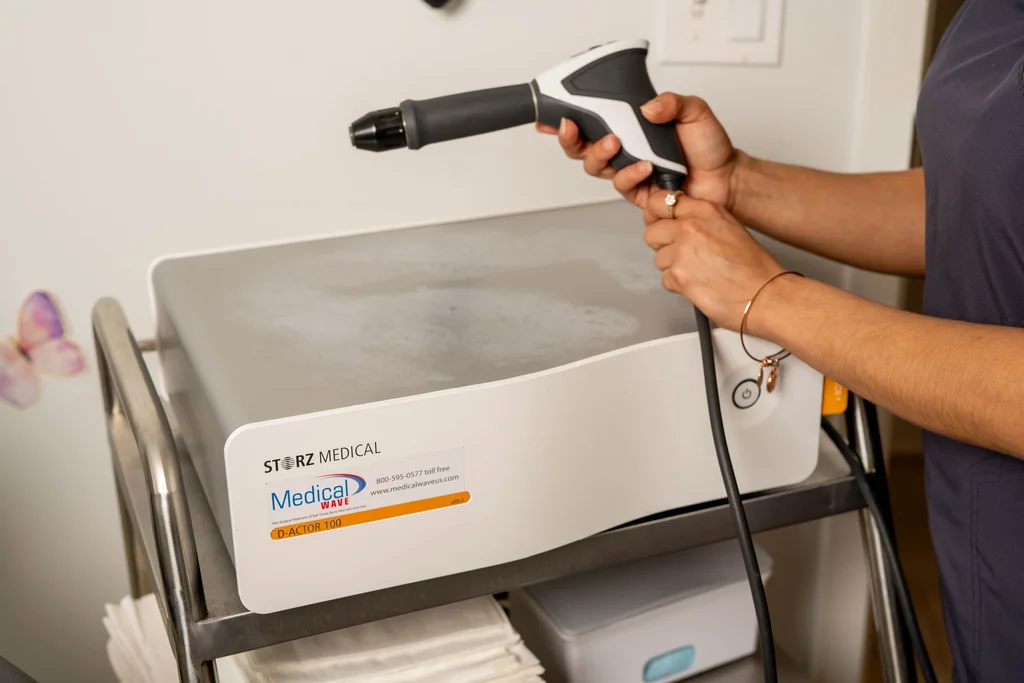
Acoustic wave therapy for Peyronie's disease at AgeRejuvenation uses focused sound waves to target the plaque and improve circulation, while the Men's Sexual Wellness PRP delivers platelet-rich plasma to support remodeling and reduce inflammation. The two are frequently combined for more complete results. The American Urological Association provides clinical guidance on the management of Peyronie's disease across surgical and non-surgical options.
How does Peyronie's disease connect to erectile dysfunction?
Answer: The two are closely linked. Reduced rigidity from erectile dysfunction makes the penis more vulnerable to the bending injuries that trigger plaque, and plaque in turn can interfere with the firmness and comfort of an erection.
Because they reinforce one another, a thorough workup looks at both at once. Many men with Peyronie's disease also have some degree of erectile dysfunction, and addressing blood flow and tissue health can improve both problems together. Vascular and metabolic factors, including diabetes and high blood pressure, influence each condition, which is why circulation and overall health are part of the evaluation.
When should you see a provider about penile curvature?
Answer: See a provider as soon as you notice new curvature, painful erections, a lump under the skin, or changes in length or function. Early evaluation matters because plaque is easier to influence before it hardens.
There is no reason to wait until the condition is severe, and the topic, while difficult to raise, is one men's health providers address regularly and discreetly. Care here is led by Chief Medical Director Dr. Dawn Ericsson, MD, and a team that evaluates penile and sexual health conditions in a private, judgment-free setting. The goal is a clear diagnosis and a non-surgical plan that targets the scar tissue itself rather than only managing symptoms around it. You can book an appointment to start with a focused, confidential evaluation.
Common symptoms
Symptoms evaluated at AgeRejuvenation include:
How we treat peyronie's disease
Care plans are personalized to the root cause. Treatments include:
- Acoustic wave therapy for Peyronie's disease at AgeRejuvenation: PulseWAVE RX acoustic wave therapy uses targeted sound waves to break down the fibrous plaque that drives curvature while stimulating new blood vessel growth. This non-surgical approach can reduce pain and curvature without incisions or downtime.
- Men's Sexual Wellness PRP: Men's Sexual Wellness PRP uses platelet-rich plasma drawn from your own blood to deliver growth factors that support tissue remodeling and reduce inflammation around the scar. It is often combined with acoustic wave therapy to improve both curvature and erectile function.