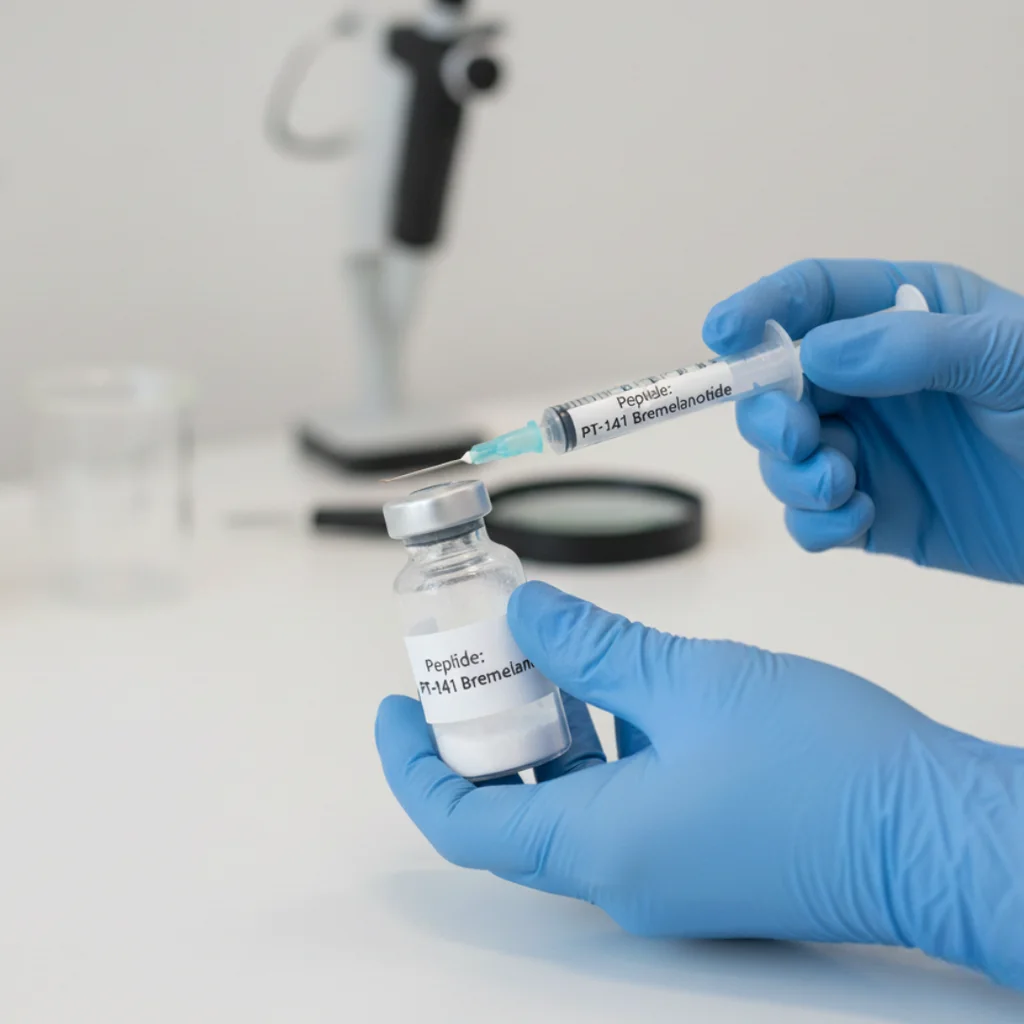
Many treatments for low desire or arousal focus on blood flow to the genital tissue. Bremelanotide, often called PT-141, takes a different route. It is a synthetic peptide that activates melanocortin receptors in the brain, the receptors tied to the desire and arousal signal itself. That central mechanism is why it has been studied for people who do not respond to vascular-based options and why it has been used for both women and men. Bremelanotide is prescribed and supervised by Dr. Dawn Ericsson and the AgeRejuvenation clinical team after a careful review of your history and goals.
At AgeRejuvenation, bremelanotide is prescribed from your individual picture, not handed out as a one-size product. This guide explains what bremelanotide (PT-141) is, how its central nervous system mechanism differs from blood-flow treatments, what it may support for women and men, who is a candidate, how it is administered, the side effects and safety considerations, and how it compares to common alternatives. Because this is sexual health care, every plan is reviewed and supervised by our clinical team.
What Is Bremelanotide (PT-141)?
Answer: Bremelanotide, also called PT-141, is a synthetic melanocortin peptide that activates melanocortin receptors in the brain to support sexual desire and arousal. It is given as a small subcutaneous injection rather than working mainly through blood flow.
Bremelanotide was developed from melanotan II, a compound first studied for skin pigmentation, and its activity on the desire-and-arousal pathway redirected later research toward sexual function. Because it acts centrally, it has been studied as an option for people whose concern is arousal or desire rather than purely vascular, as the NIH summarizes in the clinical reference on bremelanotide as a melanocortin receptor agonist. It is part of our peptide therapy program, and whether it fits you is a clinical decision made after review.
How Does Bremelanotide Work?
Answer: Bremelanotide is an agonist at melanocortin receptors, mainly MC4R, in the hypothalamic and limbic regions of the brain. By activating these receptors it increases the neural drive toward sexual arousal rather than changing blood flow.
The melanocortin system includes five receptor subtypes (MC1R through MC5R), and the MC3R and MC4R receptors are tied to energy balance, stress, and sexual function. Research describing the brain pathway behind bremelanotide explains how this central action differs from peripheral, blood-flow-based treatments. The result is desire that is initiated at the neurological level rather than facilitated at the vascular level.
What May Bremelanotide Support?
Answer: Bremelanotide may support increased sexual desire and arousal in both women and men, particularly when the underlying concern is reduced arousal rather than a purely vascular problem.
Because desire has hormonal, psychological, relational, and neurological inputs, bremelanotide addresses the neurological component. Patients have used it in the context of decreased arousal, low libido, reduced genital sensation, and difficulty reaching orgasm, often alongside hormone optimization. These are described as outcomes that may improve for appropriate candidates, not guaranteed results, and your response is monitored over time.
Who Is a Candidate for Bremelanotide?
Answer: Good candidates are adults with reduced sexual desire or arousal, especially those who have not responded well to blood-flow-based medications, after a clinical review of hormones, medications, and medical history.
Bremelanotide is FDA-approved as Vyleesi for hypoactive sexual desire disorder in premenopausal women, and the same molecule has been used more broadly under clinical supervision. Candidacy is never assumed; our team weighs your history, current medications, blood pressure, and goals first. People with uncontrolled high blood pressure or certain cardiovascular concerns may not be appropriate, which is one reason supervision matters.
How Is Bremelanotide Administered?
Answer: Bremelanotide is given as a subcutaneous injection, under the skin rather than into muscle, taken before anticipated sexual activity. A commonly studied dose is 2mg, and effects can last up to 72 hours for many patients.
The injection is simple and self-administered after instruction, which appeals to patients who want flexibility without a daily routine. Timing and dose are individualized; our team starts conservatively and adjusts based on your response and tolerability rather than applying a fixed protocol to everyone.
Bremelanotide vs. Blood-Flow Treatments
Answer: Blood-flow medications such as sildenafil and tadalafil work peripherally by increasing blood flow to genital tissue; bremelanotide works centrally on brain receptors that drive desire. They target different parts of the sexual response.
| Feature | Bremelanotide (PT-141) | PDE5 inhibitors (sildenafil, tadalafil) |
|---|---|---|
| Primary mechanism | Central, melanocortin receptors in the brain | Peripheral, increased genital blood flow |
| Targets | Desire and arousal signal | Erectile or vascular response |
| Form | Subcutaneous injection | Oral tablet |
| Studied for | Women and men | Primarily male erectile concerns |
| Typical duration | Up to 72 hours in many patients | Several hours, varies by drug |
This is why a central-pathway option may help when vascular treatments have not, and the two address different aspects of sexual function. The right choice depends on the underlying cause, which is exactly what a clinical evaluation is for.
What Are the Side Effects and Safety Considerations?
Answer: The most commonly reported effects are nausea, flushing, headache, and transient increases in blood pressure; most are mild, dose-related, and short-lived. Bremelanotide is intended for supervised use.
A review of bremelanotide safety across clinical studies describes nausea as the most frequent side effect, along with the temporary blood-pressure changes that make blood-pressure screening part of responsible care. Skin darkening (hyperpigmentation) has also been reported, particularly with repeated dosing. Because of the blood-pressure effect, candidacy and dosing are individualized and monitored, never set-and-forget.
Can Bremelanotide Be Combined With Hormone Therapy?
Answer: Yes, and pairing it with hormone optimization is often the more effective approach. Balanced hormones such as testosterone, estrogen, and DHEA provide the foundation on which bremelanotide acts.
Many patients see better outcomes when the hormonal substrate is addressed first, then layered with a central-pathway peptide. Our integrative model lets us coordinate both, so sexual health is addressed from more than one angle in a single supervised plan rather than in isolation.
What Should I Expect From Treatment?
Answer: Expect a consultation and history review first, then conservative dosing, an injection taken before anticipated activity, and follow-up to refine dose based on your response and tolerability.
There is no fixed result promised; the goal is a plan that fits your physiology and comfort. We explain what bremelanotide does and does not do, set realistic expectations, and adjust over time. Sexual health is treated as a legitimate medical concern that deserves the same thoughtful care as any other.
Why Choose AgeRejuvenation for Bremelanotide?
Answer: Sexual health is a medical concern, and bremelanotide is prescribed with full clinical context rather than dispensed without review.
Care is led by Dr. Dawn Ericsson and a team experienced in peptide and hormone therapy. We review your hormone panel, medical history, current medications, and blood pressure before prescribing, referencing the federal approval record for the bremelanotide injection and current safety literature so your plan is grounded in evidence. Bremelanotide sits within our supervised peptide therapy services, which let us coordinate hormonal balance and metabolic wellness as one strategy. To explore whether it is right for you, ask our team about our broader peptide therapy program at your consultation.
Explore more in our wellness center services .