
Food sensitivity tests are not accurate enough to diagnose a food allergy or intolerance on their own. IgG antibodies largely reflect what you eat, and allergy organizations recommend against using them for diagnosis. Used carefully, a panel can suggest where to start a short, supervised elimination and reintroduction, which is the step that actually shows whether a food or additive affects you.
Food sensitivity tests are not accurate enough to diagnose a food allergy or intolerance by themselves. The common IgG panels measure antibodies that mostly reflect which foods you eat regularly, and the American Academy of Allergy, Asthma and Immunology (AAAAI) recommends against using them for diagnosis.
Used carefully, a panel can help choose where to start a short, structured elimination and reintroduction, and that step is what actually shows whether a food affects you.
We offer food sensitivity testing, so we think you deserve a straight answer about what it can and cannot do. Here is how to read the results honestly and when a different test makes more sense.
The Short Answer: What IgG Food Tests Can and Cannot Do
An IgG panel cannot:
Diagnose a food allergy. True allergies involve a different antibody, IgE.
Diagnose celiac disease or lactose intolerance, which have their own validated tests.
Prove that a food is causing your bloating, brain fog or fatigue.
An IgG panel can:
Show which foods your immune system has been exposed to and responded to.
Give you and your provider a shortlist of candidates for a time-limited elimination.
Make a vague problem more manageable when whole-diet guesswork has not worked.
Allergy, Sensitivity and Intolerance Are Not the Same Thing
These words get used interchangeably, but they describe different problems with different tests.
Food allergy (IgE)
A food allergy is an immune reaction to a protein in food. The FDA notes that symptoms usually appear within minutes to a few hours and range from hives and lip swelling to anaphylaxis, which can be life-threatening. Allergies are diagnosed by an allergist, not by an IgG panel.
Food intolerance
The AAAAI describes an intolerance as the body not processing or digesting a food properly. It can be uncomfortable but is not dangerous. Lactose intolerance is the classic example, and the NIDDK notes that doctors can diagnose it with a hydrogen breath test.
Celiac disease
Celiac disease is an autoimmune condition triggered by gluten. The NIDDK explains that doctors diagnose it with blood tests and small-intestine biopsies, and they advise against starting a gluten-free diet before testing because it can affect the results.
Food "sensitivity"
This is the loosest category: delayed, non-allergic symptoms that seem linked to certain foods. It is what IgG panels claim to map, and it is where the evidence is weakest.
What Allergy Experts Say About IgG Testing
The AAAAI is direct: it says the IgG food test "has never been scientifically proven" to do what it claims. Its patient guidance explains that the presence of IgG is likely a normal immune response to eating a food, and that higher IgG4 levels may simply be associated with tolerance to that food.
A European Academy of Allergy and Clinical Immunology task force reached the same conclusion in 2008, and the AAAAI formally supported that position in 2010. The AAAAI and the Canadian Society of Allergy and Clinical Immunology both recommend against using IgG testing to diagnose food allergy or intolerance.
That means a long list of "reactive" foods on a report is not, by itself, a reason to cut them all. People who do that can end up on a needlessly restrictive diet for months.
How We Use Food Sensitivity Testing
So why offer the test at all? Because some patients have already tried the obvious changes, still feel unwell, and need a structured place to start. Used with clear limits, a panel can narrow the search.
Our food sensitivity testing uses a blood sample to measure IgG and IgA antibody responses to more than 200 foods. Here is how we read it:
Results are clues, not a diagnosis. We compare the report with your symptom history, timing and what you actually eat.
We pick a short list, not the whole report. Only foods that both stand out on the panel and fit your history go into an elimination trial.
Elimination is time-limited. Structured plans such as the low-FODMAP diet, as Cleveland Clinic describes it, remove foods for two to four weeks and then add them back systematically.
Reintroduction is the real test. If symptoms return when a food comes back, that tells us far more than the antibody number.
We keep the diet as broad as possible. The goal is to identify a few true triggers, not to remove food groups indefinitely.
Structured elimination and reintroduction with a nutrition counselor helps keep meals balanced while you test. One more practical point: antibody levels reflect recent exposure, so foods you have already cut out may read low simply because you have not eaten them.
Food Additive Panels: Sulfites, Carrageenan, Dyes and Emulsifiers
Sometimes the trigger is not the food but something added during processing. A person may tolerate a meal made at home and feel different after a packaged version of the same thing.
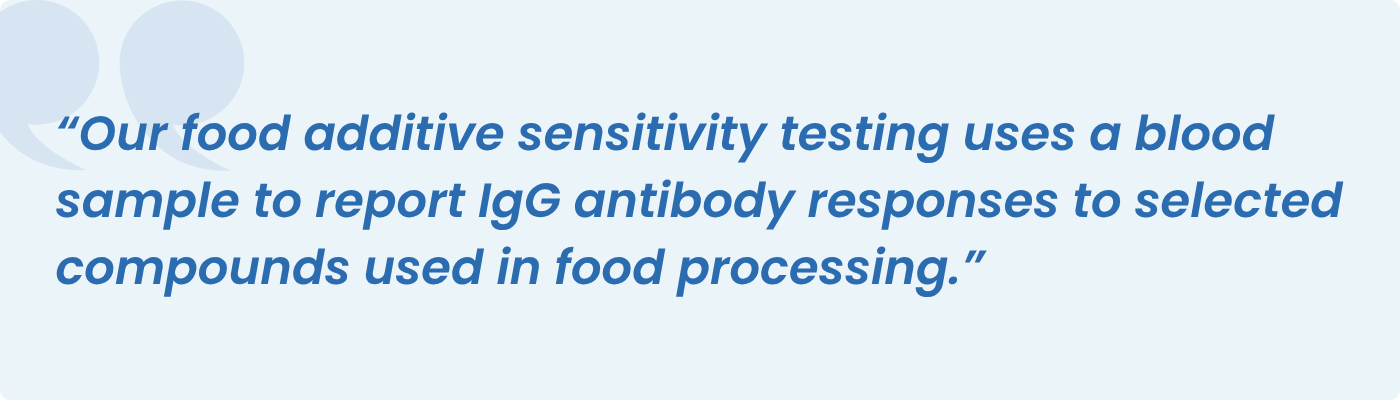
Our food additive sensitivity panel uses a blood sample to report IgG responses to selected additives such as preservatives, colorings and emulsifiers.
The same limits apply: an elevated result shows immune recognition, not proof that the additive causes your symptoms. The evidence on individual additives is uneven, so it helps to know where it is strong and where it is still early.
Sulfites
Sulfite reactions are well documented. The FDA requires sulfites to be declared on food labels at 10 parts per million or more, in part because of reactions such as asthma in sensitive people. A 2009 review in Clinical and Experimental Allergy found that most studies report sulfite sensitivity in 3 to 10 percent of people with asthma.
Carrageenan side effects
Carrageenan is a seaweed-derived thickener that the FDA permits as a food additive. The human evidence on side effects is limited.
In a small 2017 trial of 12 people with ulcerative colitis in remission, those given carrageenan capsules relapsed sooner than those given placebo. That is an early signal for people with inflammatory bowel conditions, not proof of harm for everyone.
Emulsifiers
In a 2022 controlled feeding study in Gastroenterology, healthy adults who ate the emulsifier carboxymethylcellulose for 11 days had a modest increase in post-meal abdominal discomfort and reduced gut microbiome diversity compared with people on an emulsifier-free diet. The study was small, but it is one of the few in humans.
Artificial dyes
The FDA requires Yellow 5 to be named on food labels so people who are sensitive to it can avoid it. For most dyes, reading labels and testing a few weeks without them is more informative than any blood test.
When Bloating, Brain Fog or Fatigue Point Somewhere Else

These symptoms are common, and food is only one possible cause. Before blaming a food, it is worth ruling out other explanations:
Celiac disease, which needs testing while you are still eating gluten
Lactose intolerance, which a breath test can confirm
Ongoing gut inflammation or changes in the gut microbiome
Thyroid problems, which the NIDDK notes can cause fatigue and weight gain
Poor sleep, stress, blood sugar swings and hormone changes
When digestive symptoms dominate, GI-MAP stool testing can look at the microbiome and markers of inflammation, which a food panel cannot.
Red Flags: When It Is a Real Allergy
Do not use a sensitivity test to investigate fast or severe reactions. The FDA lists allergic reaction symptoms that include hives, flushed skin, tingling in the mouth, swelling of the face, tongue or lips, vomiting, coughing or wheezing, and dizziness. Anaphylaxis is a medical emergency: call 911.
If you have ever had a reaction like that, see an allergist for IgE-based testing before making any diet changes on your own.
Is a Food Sensitivity Test Worth It?
It can be, for the right person and with the right expectations. It tends to be most useful if:
You have ongoing digestive, skin or energy symptoms that have not improved with basic diet changes
Allergy testing was negative and celiac disease has been ruled out
You want a structured starting point instead of cutting foods at random
You will commit to a short elimination and a careful reintroduction
It is not worth it as a stand-alone answer, a substitute for allergy testing, or a reason to remove dozens of foods.
Before paying for any food sensitivity test, from us or anyone else, ask a few questions:
Who will interpret the results with my history, and when?
Will I get a written elimination and reintroduction plan?
Has celiac disease been ruled out, or should it be tested first?
How many foods will I be asked to remove, and for how long?
If the answers are vague, the test is unlikely to help.
Frequently Asked Questions
Are there any food intolerance tests that actually work?
Yes, for specific conditions. A hydrogen breath test can diagnose lactose intolerance, and blood tests plus a small-intestine biopsy are used to diagnose celiac disease. For general "sensitivities," the most reliable tool is still a supervised elimination followed by reintroduction.
What are the first signs of a food intolerance?
The AAAAI notes that classic food intolerances, such as lactose intolerance, cause bloating, fullness, belly pain, gas or diarrhea when you eat too much of the food. Symptoms that come on within minutes, especially hives, swelling or trouble breathing, point to an allergy instead.
What is the difference between IgG and IgA food sensitivity testing?
Both are antibody classes, and our panel reports both. Neither one diagnoses an allergy, which involves IgE. We read IgG and IgA results the same way: as clues that help choose which foods to test with a time-limited elimination, not as a final verdict.
Can a food sensitivity test diagnose celiac disease?
No. Celiac disease needs specific blood tests and usually a biopsy. The NIDDK advises staying on a regular diet that includes gluten until testing is complete, because going gluten-free first can make results unreliable.
How long does an elimination diet take?
Many structured plans remove suspect foods for two to four weeks and then reintroduce them one at a time, as Cleveland Clinic describes for the low-FODMAP diet. Your timeline depends on how many foods are involved and how quickly symptoms change.
Get Clear Answers Instead of a Longer Avoid List
If you have been changing your diet without getting the clarity you hoped for, we can help you sort out what is worth testing and how to use the results well. Schedule a visit or call 888-681-6521 to talk through your symptoms and whether food sensitivity or additive testing makes sense for you.

Sources
Ready to take the next step?
Talk with the AgeRejuvenation team about a Food Sensitivity Testing plan built around your labs and goals.