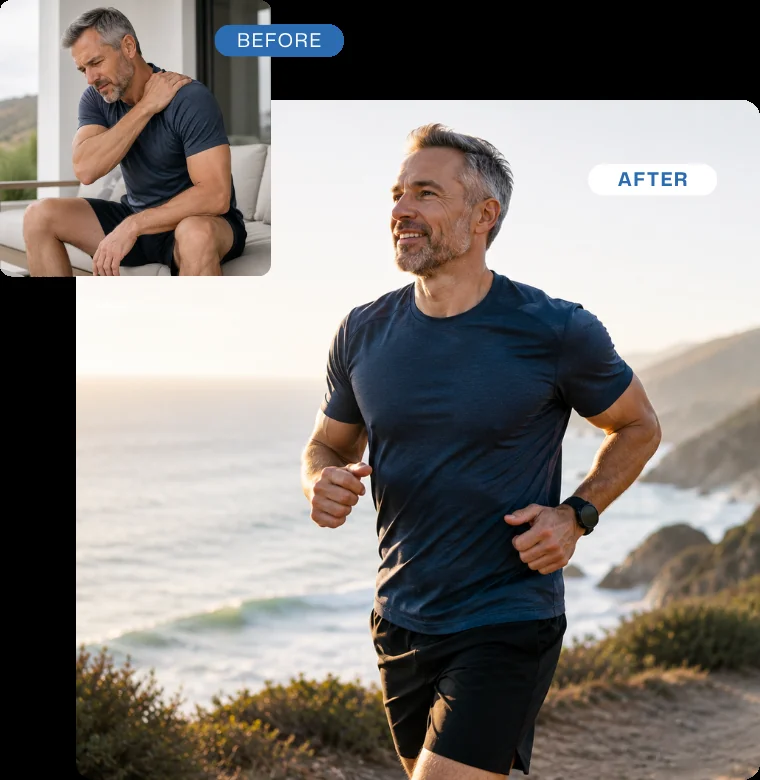
The injury that has lingered for two years. The shoulder where physical therapy plateaued. The Achilles that flares every time you try to run again. The gut that has never fully settled. The recovery that takes three days when it should take one. The Wolverine Blend pairs two well-studied repair peptides, BPC-157 and TB-500, to engage the body's healing cascade directly rather than just managing the symptom. When the protocol is built around your history and supervised, many patients describe feeling like their body finally responds again.
At AgeRejuvenation, the Wolverine Blend is built around your history and goals, not a default protocol. This guide explains what the Wolverine Blend is, how its two peptides work, what it may support, who tends to be a candidate, how it is administered, the safety considerations, what patients commonly report over time, and how it compares to running a single peptide. Throughout, we frame what is genuinely studied as "may support" rather than as a promise, because regenerative peptides are an evolving area of medicine.
What Is the Wolverine Blend?
Answer: The Wolverine Blend is a single-injection combination of two repair peptides, BPC-157 and TB-500, that targets the overlapping steps of the body's healing cascade rather than treating just one part of recovery.
BPC-157 (Body Protective Compound 157) is a synthetic peptide based on a sequence found in human gastric juice, and TB-500 is a synthetic version of the active fragment of thymosin beta-4, a naturally abundant protein. Pairing them is meant to engage both the local repair signaling and the cell migration that healing depends on. The nickname references the fictional character known for rapid regeneration; it is a memorable label, not a medical claim. At AgeRejuvenation the blend is delivered under medical supervision after an evaluation, never as a one-size-fits-all package.
How Does the Wolverine Blend Work?
Answer: BPC-157 may support angiogenesis, growth-factor signaling, collagen production, and direct tissue repair, while TB-500 may support the cellular migration that brings repair cells to the site of damage; together they address overlapping stages of healing.
BPC-157 has been studied across many tissue types, including tendon, ligament, muscle, bone, skin, and the gut lining, as summarized in a research review of BPC-157 and wound healing across multiple tissue types. TB-500 derives from thymosin beta-4, which regulates actin and is described in the published profile of thymosin beta-4 as a regenerative peptide as a driver of cell movement, new vessel formation, and reduced scarring. Where one peptide supports the repair signal and the other supports getting repair cells to the right place, the combination is intended to keep those steps working in concert.
Why Combine BPC-157 and TB-500 Instead of Running One Alone?
Answer: Patients who have tried BPC-157 or TB-500 on its own sometimes see only partial results; combining them in one injection is meant to engage the full repair sequence at once and may produce a more consistent response.
There is also a practical reason. A protocol can involve daily or near-daily dosing over several weeks, so a single combined injection halves the number of injections, simplifies site rotation, and tends to improve adherence. The biological rationale is that the body's healing program is itself coordinated, so supporting cell migration and local repair signaling together, rather than in isolation, is intended to better match how tissue actually rebuilds.
What May the Wolverine Blend Support?
Answer: The Wolverine Blend may support recovery from soft-tissue injuries, chronic tendon issues, post-surgical healing, and gut-related inflammation, with the goal of faster, more complete tissue repair rather than symptom suppression.
The targets reflect where the underlying peptides have been studied: tendons and ligaments, muscle strains, slow-healing wounds, and the gut lining. Tendons in particular are slow to heal, as Cleveland Clinic notes in its overview of why injured tendons recover slowly, which is part of why chronic tendinopathy is a common reason patients ask about regenerative peptides. We are deliberate about language here: the blend may support these recovery processes, and real outcomes depend on the individual, the injury, and a supervised plan.
Who Is a Candidate for the Wolverine Blend?
Answer: Good candidates are generally adults with a stubborn or slow-healing injury, athletes managing overuse strain, people recovering from a procedure, or those with chronic gut and inflammatory issues, who want a supervised regenerative option.
Several profiles tend to ask about the blend: athletes and physically demanding professionals carrying chronic overuse injuries; adults with long-standing tendon problems that conventional care has plateaued on; people in post-surgical or post-traumatic recovery; patients with chronic gut and inflammatory conditions; and adults whose work or history loads the body with repeated physical stress. Candidacy is confirmed during evaluation, where the medical team reviews your injury, prior treatments, imaging where relevant, current medications, and goals to decide whether the blend is appropriate.
How Is the Wolverine Blend Administered?
Answer: The Wolverine Blend is given as a subcutaneous injection, usually daily or near-daily during the active recovery phase, with patients self-administering at home after in-clinic training.
Initial protocols commonly run six to twelve weeks, with longer courses for complex or chronic cases and maintenance schedules afterward where appropriate. The exact schedule is set by the clinical team for each patient rather than copied from a template, and any dosing decisions are made in the visit, not from a webpage. The aim is a plan you can realistically sustain, since regenerative results build over weeks rather than in a single session.
What Are the Side Effects and Safety Considerations?
Answer: Reported tolerability of these peptides is generally favorable in the literature, but they are not FDA-approved drugs, long-term human safety data is limited, and use should always be medically supervised.
It is important to be honest about the evidence base: much of the research on BPC-157 and thymosin beta-4 comes from preclinical and animal studies, and large long-term human trials are still limited. That is exactly why supervision matters. The most common practical considerations are localized injection-site reactions and the need for correct technique and site rotation. Anyone considering the blend should disclose their full medical history, current medications, and any history of cancer, since regenerative signaling pathways warrant caution and individualized review.
What Do Patients Report Over Time?
Answer: Patients often describe subtle changes in the first one to two weeks, more noticeable improvement between weeks two and six, and the most meaningful change by the end of an eight-to-twelve-week protocol.
Early on, the shifts tend to be modest: a quieter inflammatory tone, slightly less morning stiffness, better tolerance of activities that used to aggravate the issue. Through the middle of a protocol, many report less pain, improved range of motion, and a gradual return of activities that had been off-limits. By the end of a full course, some describe the underlying condition as changed rather than just managed. These are reported patterns, not guaranteed outcomes, and progressive loading, sleep, and nutrition all influence how the recovery goes.
How Does the Wolverine Blend Compare to a Single Peptide?
Answer: Running BPC-157 or TB-500 alone targets one half of the repair process, while the Wolverine Blend combines both in one injection to engage the full healing sequence, which is why it is often chosen for stubborn or complex injuries.
| Option | Primary focus | Injections | Often considered for |
|---|---|---|---|
| BPC-157 alone | Local repair signaling, angiogenesis, collagen support | One peptide | Patients targeting a specific tissue or gut-related issue |
| TB-500 alone | Cellular migration, actin regulation, vessel support | One peptide | Patients focused on cell-mobility support |
| Wolverine Blend | Both repair signaling and cell migration combined | One combined injection | Stubborn, chronic, or multi-tissue recovery goals |
The right choice depends on your injury, your goals, and the medical team's assessment. For some patients a single peptide is the better starting point; for others the combination is selected from the outset. That decision is made in the clinic, not from a default.
Why Choose AgeRejuvenation for the Wolverine Blend?
Answer: Regenerative peptide care done well is individual and supervised, which a rushed visit cannot deliver, and AgeRejuvenation builds each protocol around the patient.
Every protocol begins with a comprehensive evaluation of your injury, history, prior treatments, and goals, and the team determines whether the Wolverine Blend on its own or a broader recovery plan will serve you better. We explain what each peptide is intended to do and why your protocol looks the way it does, so you are a partner in your care. The Wolverine Blend is one option within our broader regenerative wellness and recovery care; you can also explore the full peptide therapy program to see how it fits alongside other supervised protocols.
Explore more in our wellness center services .