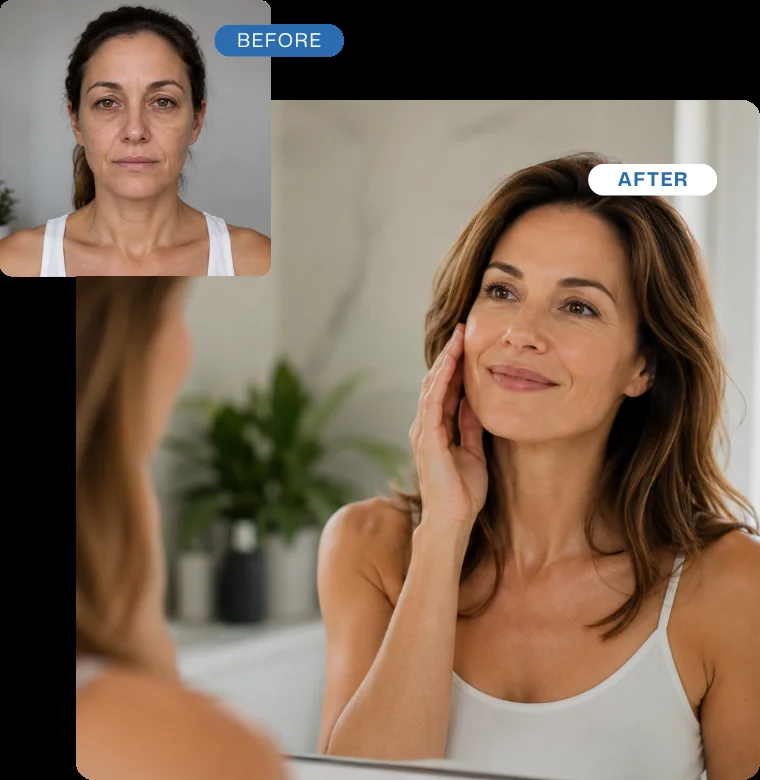
Most people asking about regenerative care want two things at once. They want to look better, with clearer skin and a complexion that reflects the energy they still feel inside. And they want to feel better, recovering faster and regaining the physical resilience that used to be automatic. The GLOW peptide stack was built around the idea that, at the cellular level, skin quality and tissue repair run on the same biology. It combines three peptides chosen for distinct, complementary roles in regeneration.
At AgeRejuvenation, GLOW is a precision-built peptide stack, GHK-Cu, BPC-157, and TB-500, prescribed and supervised by our clinical team rather than self-selected. This guide explains what GLOW is, what each peptide does, the regenerative processes it may support, who tends to be a candidate, how it is administered, what the safety considerations are, what to expect over a protocol, and how a three-peptide stack compares to a single peptide. It is educational and not a substitute for a medical evaluation.
What Is the GLOW Peptide Stack?
Answer: GLOW is a three-peptide therapeutic stack combining GHK-Cu, BPC-157, and TB-500. Each peptide addresses a distinct lever of regenerative biology, so together they may support collagen synthesis, tissue repair, and the blood supply that feeds both.
Peptides are short chains of amino acids, and MedlinePlus explains how short chains of amino acids act as signaling molecules in the body. GLOW pairs three of them: GHK-Cu (a copper tripeptide), BPC-157 (Body Protective Compound 157), and TB-500 (a thymosin beta-4 fragment). For decades, aesthetic and regenerative goals were treated as separate categories, the surface handled by cosmetic care and function handled by recovery protocols. The premise behind GLOW is that, at the cellular level, the processes behind skin quality and the processes behind tissue repair overlap. At AgeRejuvenation, GLOW is one of the more requested protocols within our peptide therapy program.
How Does GLOW Work in the Body?
Answer: Each GLOW peptide signals a different part of the repair cascade. GHK-Cu cues fibroblasts toward collagen and elastin, BPC-157 supports healing and new blood vessel formation, and TB-500 helps mobilize repair cells to damaged tissue.
GHK-Cu is studied for its role in signaling skin cells toward collagen and elastin production, part of the broader literature on the studied roles of therapeutic peptides in aesthetic and regenerative care. BPC-157 supports angiogenesis, which improves perfusion to skin and other tissues, and better blood flow means better delivery of oxygen and nutrients to healing tissue. TB-500, a fragment related to thymosin beta-4, is studied for helping repair cells migrate to sites of damage. Run together, the intent is a broader regenerative response than any single component is expected to produce alone.
What May GLOW Support?
Answer: GLOW may support skin regeneration, collagen and elastin synthesis, connective-tissue and wound repair, gut-lining integrity, and recovery resilience. These are framed as may-support effects, not guarantees, and individual responses vary.
Much of the interest in GLOW comes from its overlap of aesthetic and regenerative aims. Patients pursuing skin quality, tone, texture, and clarity are drawn to peptides that work by supporting the underlying tissue rather than masking the surface. Those recovering from tendon strain, partial muscle tears, or slow-healing wounds are drawn to the same biology from the repair side. Because evidence for many peptides is still developing, AgeRejuvenation frames goals as realistic support rather than promised outcomes, and tailors expectations to your evaluation.
Who Is a Candidate for GLOW?
Answer: Candidates are generally adults seeking non-surgical skin renewal or improved tissue recovery who pass a clinical screen covering health history, medications, and goals. GLOW is not appropriate for everyone, and candidacy is decided during a medical consultation.
The patient profile is broad because the underlying biology applies to many adults, but suitability is individual. People with active cancer, certain medical conditions, pregnancy, or specific medication interactions may not be candidates, which is exactly why every GLOW plan begins with a clinical review. Some patients losing weight on GLP-1 protocols ask about GLOW to help support skin quality as body composition changes; whether that fits is a conversation to have with the clinician, not an assumption.
How Is GLOW Administered?
Answer: GLOW is typically self-administered by subcutaneous injection after in-clinic training, and GHK-Cu can also be incorporated into a topical formulation for direct skin application alongside the systemic protocol.
Delivery is part of why peptide stacks are handled under supervision rather than over the counter. After your evaluation, the clinical team provides training so injections are done correctly and comfortably at home, and follow-up keeps the protocol on track. The systemic and topical routes can be combined for skin-focused goals. Your exact regimen is set during your visit, not from a generic template, and we do not publish injection amounts as advice because dosing is a clinical decision tied to the individual.
GLOW Stack vs. a Single Peptide
Answer: A single peptide targets one lever of repair, while the GLOW stack layers three complementary mechanisms, collagen signaling, healing and perfusion, and repair-cell migration, for a broader regenerative response that one compound is not expected to match alone.
The table below summarizes the role each component plays. It describes mechanisms studied in the literature, not promised results.
| Component | Primary studied role | What it contributes to the stack |
|---|---|---|
| GHK-Cu (copper tripeptide) | Signaling toward collagen and elastin synthesis | Skin-quality and structural support |
| BPC-157 | Tissue healing and angiogenesis | Cross-tissue repair and better perfusion |
| TB-500 (thymosin beta-4 fragment) | Repair-cell migration and vascular support | Directs and amplifies the healing response |
| GLOW (all three together) | Coordinated multi-pathway regeneration | A broader response than any single peptide |
Because each peptide addresses a different biological layer, the stack is a strategic combination rather than a collection of unrelated compounds. That coordination is also why it belongs under supervised peptide therapy rather than ad hoc supplementation.
Is GLOW Safe? Side Effects and Considerations
Answer: Peptide therapy is generally well tolerated under supervision, but possible considerations include injection-site reactions and individual sensitivities. GLOW is prescribed and monitored, and several of these peptides are research-stage rather than broadly FDA-approved drugs.
Honesty matters here: the evidence base for peptides like BPC-157 and TB-500 is still developing, much of it preclinical, and they are not approved drugs for general use, so they are handled within a supervised, individualized clinical context. The most commonly discussed considerations are mild and local, such as redness or tenderness at an injection site. Anyone with a relevant medical history should disclose it during screening. This is why GLOW is clinician-directed rather than self-prescribed, and why monitoring is part of the plan.
What Results Can You Expect, and When?
Answer: Many patients describe early skin and energy changes within the first few weeks, with more visible shifts often reported between weeks three and six. Timelines and degree of change vary by person, and these are typical patterns, not guarantees.
The visible expression of regenerative activity is what gives GLOW its name. Patients commonly describe skin that looks more luminous and a clearer under-eye area as a protocol progresses, with deeper tissue effects accumulating over weeks and months. Research on thymosin beta-4 and tissue repair and on BPC-157 helps explain the mechanisms behind why repair can continue building over time, though the pace and extent differ for each individual.
How Does GLOW Fit With Aesthetic Procedures?
Answer: Advanced aesthetic procedures such as microneedling, radiofrequency, and PRP create controlled micro-injuries; pairing them with a regenerative peptide protocol may support the healing response that drives those results.
When the skin is intentionally injured to stimulate renewal, the quality of the healing response shapes the outcome. Supporting that healing with a protocol aimed at collagen and tissue repair is the rationale for combining GLOW with in-office aesthetic treatments. Whether and how to sequence them is determined by your clinician based on your skin, your goals, and your treatment calendar.
Why Choose AgeRejuvenation for GLOW?
Answer: A three-peptide stack requires clinical coordination, not supplement guesswork. At AgeRejuvenation, every GLOW protocol starts with a consultation covering your goals, health conditions, medications, and relevant lab work, supervised by experienced clinicians.
Dr. Dawn Ericsson, our Chief Medical Officer, leads protocol design across all five Florida locations, drawing on nearly two decades of building a comprehensive longevity and precision-medicine practice. GLOW sits within our broader peptide therapy program, where it can be considered alongside hormone optimization, NAD+ therapy, and other interventions for patients seeking regenerative results. Care is explained so you understand what each peptide is doing and why your protocol looks the way it does.
Explore more in our wellness center services .