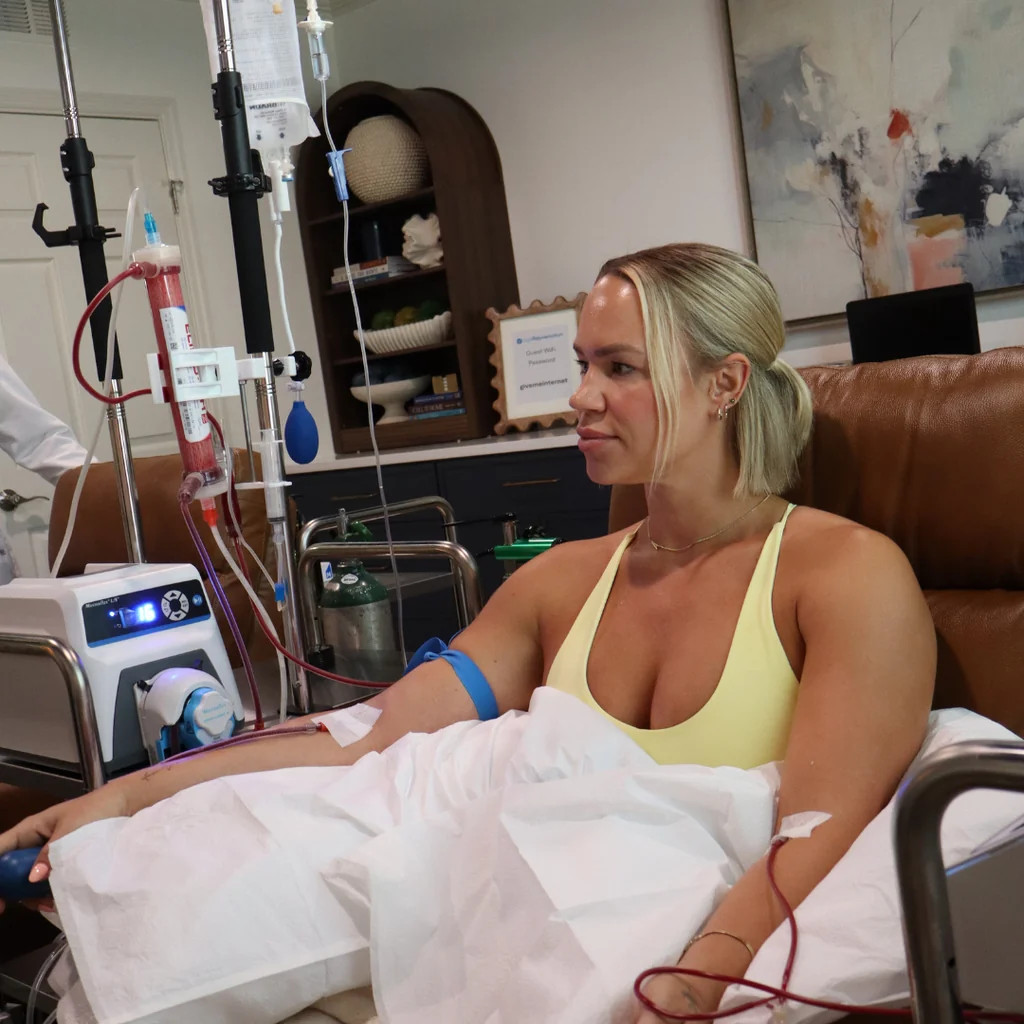
You have tried anti-inflammatory diets, rested, and taken supplements, yet the inflammation lingers, your immune system still feels depleted, and your energy has not fully returned since you got sick. Cellular plasma recharge, also called Extracorporeal Blood Oxygenation and Ozonation (EBOO), takes a different path. It draws your blood, filters out cellular debris, and exposes it to calibrated ozone and oxygen before returning it, supporting the detoxification, oxygenation, and immune resilience that diet and supplements alone often cannot reach.
At AgeRejuvenation, cellular plasma recharge is built around your labs and goals, not a default protocol. We evaluate your markers and history first, then use it to filter and re-oxygenate your blood, and we monitor your response over time. The therapy is offered exclusively at our South Tampa clinic. This guide explains what cellular plasma recharge is, how it differs from standard ozone therapy and routine IV infusions, who tends to benefit, the advantages and the real risks, how many sessions to expect, and what treatment costs.
What Is Cellular Plasma Recharge?
Answer: Cellular plasma recharge is an advanced IV ozone therapy that draws your blood, filters out cellular debris, and ozonates it before returning the treated blood to circulation.
A specialized device processes a larger blood volume than minor ozone injections and combines filtration with ozonation in one continuous cycle. The ozone molecule (O3) is highly reactive, and when it contacts blood it generates byproducts called ozonides and lipid peroxides. These trigger a cascade of responses: greater oxygen-carrying capacity, activation of antioxidant enzyme systems, modulation of immune cell activity, and reduction of oxidative stress markers. Research published in the journal Antioxidants describes ozone therapy's mechanisms including improved oxygen metabolism and immune modulation.
How Is Cellular Plasma Recharge Different From Standard Ozone Therapy?
Answer: Cellular plasma recharge processes blood continuously with real-time filtration, removing cellular waste while ozonation occurs, whereas conventional major autohemotherapy treats a fixed blood volume and returns it without filtering.
That simultaneous filtration is the defining characteristic. Standard ozone modalities ozonate a set amount of blood and return it; this therapy cleans waste products out of the blood at the same time it ozonates, producing a cleaner end result in a single session. This distinction matters most for patients whose primary goal is systemic detoxification alongside oxygenation support rather than a single targeted injection.
How Is It Different From Standard IV Therapy?
Answer: Standard IV therapy delivers fluids and nutrients into your bloodstream; cellular plasma recharge goes further by withdrawing blood, filtering out debris, and ozonating it before returning it, adding purification and oxygenation that infusions cannot replicate.
Routine IV infusions are additive, putting something into your circulation. Cellular plasma recharge is both subtractive and additive, removing cellular debris while delivering calibrated oxygen and ozone byproducts. For patients who want detoxification support layered on top of nutrient delivery, that combination is the appealing difference.
Who Is a Candidate for Cellular Plasma Recharge?
Answer: Candidates are generally adults pursuing detoxification, inflammation management, immune support, or post-illness recovery, who have completed an evaluation confirming it is an appropriate part of their wellness plan.
Patients commonly seek cellular plasma recharge for chronic low-grade inflammation and tissue recovery, slow post-surgical or post-injury healing, immune system support, lingering fatigue and cognitive fog after a significant illness, and proactive wellness optimization. It is not a standalone cure for any of these. We work with each patient to determine whether it fits within a broader, individualized protocol, and screening rules out anyone for whom treatment is not appropriate.
How Does Cellular Plasma Recharge Work?
Answer: During treatment, blood is drawn through an access point, passed through a filter that removes cellular debris, mixed with a calibrated oxygen-ozone blend, and returned to your body in one continuous circuit.
Because the cycle is continuous, the same blood volume is purified and oxygenated steadily rather than in a single static batch. The session is supervised throughout, and your provider sets the ozone concentration and flow based on your evaluation. Ozone is delivered only into the blood through this closed circuit and is never inhaled, a basic safety boundary in any responsible ozone protocol.
What Are the Benefits of Cellular Plasma Recharge?
Answer: Reported benefits include support for detoxification, improved oxygen delivery to tissue, immune modulation, and reduced oxidative stress, which patients often pursue for inflammation, recovery, and general wellness.
Improving circulation and oxygenation can help blood and oxygen reach inflamed or healing tissue more efficiently, which is why patients with musculoskeletal strain or slow recovery often explore it. The proposed mechanism centers on the body's antioxidant defenses, and the National Library of Medicine explains how antioxidants help counter the oxidative stress linked to chronic disease. The immune-modulating effects of ozone therapy are among the most studied aspects of this intervention in the clinical literature. The size and durability of any benefit vary by person, which is why we tie the protocol to lab findings and reassess rather than promising a fixed outcome.
Cellular Plasma Recharge vs. Other Ozone Methods
Answer: Cellular plasma recharge, major autohemotherapy, and minor ozone injections all use medical ozone, but they differ in how much blood is processed, whether filtration is included, and how often sessions are done.
| Method | How it works | Blood volume | Filtration |
|---|---|---|---|
| Cellular plasma recharge | Continuous draw, filter, and ozonate, then return | Larger, processed continuously | Yes, real-time |
| Major autohemotherapy | A fixed volume is ozonated and reinfused | Moderate, fixed batch | No |
| Minor ozone injection | A small ozonated blood sample is injected | Small | No |
The right approach depends on your goals and your provider's assessment. Patients whose main aim is systemic detoxification alongside oxygenation tend to be drawn to it specifically because of the built-in filtration step.
What Are the Side Effects and Risks?
Answer: When performed by trained providers, the treatment is generally well tolerated; possible effects include mild discomfort at the access site, temporary fatigue, or lightheadedness, and ozone must never be inhaled.
Like any procedure involving the blood, it carries risks that depend on technique, equipment, and your individual health, which is why screening and supervision matter. A clinical overview of the safety considerations and reported uses of medical ozone underscores that proper dosing and trained administration are central to safe care. We review your history and lab markers before recommending treatment and monitor your response, rather than offering the therapy as a commodity.
How Many Sessions Are Needed?
Answer: Protocol length depends on your health status, lab results, and goals, and your provider recommends a starting series after your evaluation rather than applying a one-size-fits-all schedule.
Patients pursuing general wellness optimization often follow a different cadence than those addressing a specific health challenge. Because cellular plasma recharge is one element of a coordinated plan, the number and spacing of sessions are reassessed as your labs and how you feel evolve, not fixed in advance.
How Much Does Cellular Plasma Recharge Cost?
Answer: Cellular plasma recharge is not typically covered by standard health insurance and is usually self-pay, with cost varying by your protocol and session count; transparent pricing is provided before your first session.
Because every plan is individual, we review the full cost up front, and financing options are available. The goal is a protocol you can sustain, since the benefits of cellular plasma recharge are supported over a series rather than promised from a single visit.
Why Choose AgeRejuvenation for Cellular Plasma Recharge?
Answer: AgeRejuvenation pairs cellular plasma recharge with comprehensive lab review and a coordinated wellness plan, supervised by experienced clinicians who tailor treatment to your markers and goals.
We do not offer cellular plasma recharge in isolation. Our providers integrate it with lab findings, peptide therapy, IV nutrition, and hormone optimization as clinically appropriate, creating a coordinated approach to your specific challenges. Cellular plasma recharge anchors our broader wellness and longevity therapies, and our team focuses on sustainable outcomes rather than single-session quick fixes. If you want to learn whether it belongs in your plan, an evaluation is the place to start.
Explore more in our wellness center services .