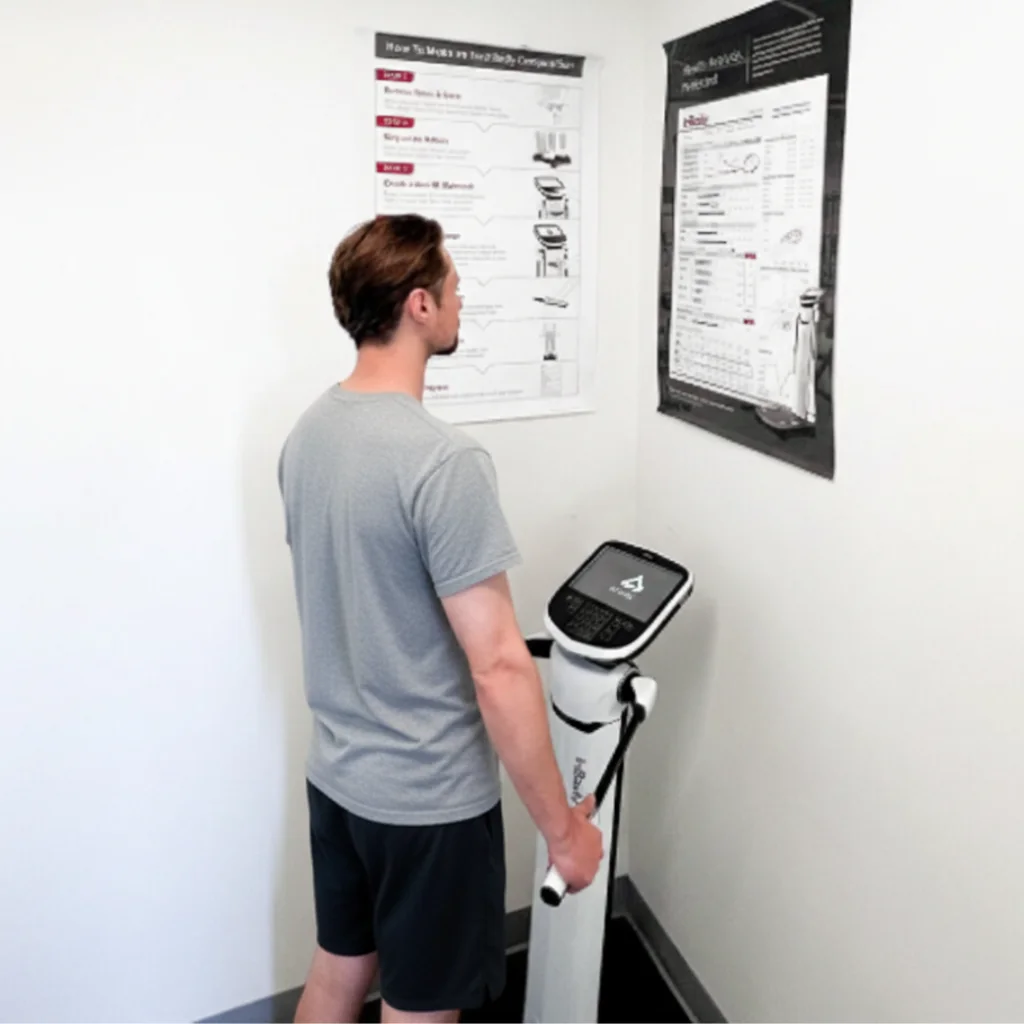
A standard scale reports a single number that hides what your body is actually made of. InBody Scale Analysis is a noninvasive body composition assessment that uses bioelectrical impedance to separate weight into skeletal muscle mass, body fat percentage, visceral fat, and total body water in under a minute. The result is an objective, repeatable baseline your provider can use to track changes over time, rather than reacting to daily weight fluctuations that may reflect water, food, or genuine tissue change.
Most people manage their health by a single number on the bathroom scale, but that figure hides far more than it reveals. This guide explains what InBody Scale Analysis measures, who should consider it, what its readings can and cannot tell you, how the scan is performed, and what your results mean for the next step in your care. It is an assessment that produces data for a provider to interpret, not a diagnosis on its own.
What Is InBody Scale Analysis?
Answer: InBody Scale Analysis is a noninvasive body composition assessment that uses bioelectrical impedance to separate your weight into skeletal muscle mass, body fat, visceral fat, and total body water in under a minute.
Rather than a single weight reading, the test produces a breakdown of the tissues that make up that weight. The National Library of Medicine describes how bioelectrical impedance estimates body composition by measuring how a safe, low-level current moves through lean tissue, fat, and fluid. This assessment is part of the advanced diagnostics and clinical care hub at AgeRejuvenation, where objective measurements inform a personalized plan.
What Does the InBody Scan Measure?
Answer: The scan reports skeletal muscle mass, body fat percentage, visceral fat level, total body water, and an estimated basal metabolic rate, with segmental breakdowns for each arm, each leg, and the trunk.
Segmental analysis matters because muscle and fluid are not distributed evenly across the body. The printout shows where lean tissue and fat sit, which gives a provider far more context than a whole-body average. These figures form a baseline that can be repeated and compared over time.
Who Should Consider an InBody Assessment?
Answer: People pursuing weight management, building muscle, recovering strength, or following a metabolic or hormone program often benefit, because the scan distinguishes real tissue change from day-to-day weight noise.
It is also useful for anyone whose weight has not moved as expected despite consistent effort, since the data can show whether muscle is being preserved or lost. The assessment is informational, and your provider decides whether it fits your goals during the consultation.
What Can InBody Results Detect?
Answer: Results can flag low skeletal muscle mass, elevated body fat percentage, an estimated visceral fat level above typical ranges, and fluid imbalances that may warrant a closer look by a clinician.
Visceral fat is the deep abdominal fat stored around the organs, and it is the reading patients ask about most. Cleveland Clinic explains why visceral fat around the organs raises metabolic risk more than fat stored just under the skin. The scan estimates this hidden fat so a provider can decide whether further evaluation is appropriate; an InBody reading alone is a screening signal, not a diagnosis.
How Does the InBody Scan Work?
Answer: You stand on the device and hold two hand electrodes while it sends a painless, low-level current through the body, measuring impedance to estimate how much of your weight is muscle, fat, and water.
Bioelectrical impedance works because lean tissue and body water conduct current readily, while fat resists it. The whole process takes under a minute and requires no needles, radiation, or undressing. There is no sample to collect in a lab sense; the measurement is taken directly through the electrodes during the brief standing scan.
How Should I Prepare for the Scan?
Answer: No fasting is required, but avoid heavy meals and intense exercise for at least four hours beforehand, arrive well hydrated, and test at the same time of day as previous scans when possible.
Because the reading reflects body water as well as tissue, hydration, recent meals, and exercise can shift the numbers temporarily. Consistent conditions make month-to-month comparisons trustworthy. These same steps help ensure a follow-up scan reflects genuine change rather than passing fluctuation.
What Do My InBody Results Mean?
Answer: Your results describe the composition of your weight at one moment in time; their value comes from how a provider interprets the trend across repeated scans, not from a single printout.
A drop in total weight is encouraging only if the underlying numbers show fat decreasing while muscle holds steady. The opposite pattern, weight loss driven partly by muscle loss, is something a provider would want to address. Every InBody analysis at AgeRejuvenation is reviewed under physician supervision so you understand what each figure means and what to consider next.
How Does InBody Compare to Other Body Composition Methods?
Answer: InBody is a fast, noninvasive bioelectrical impedance assessment; DEXA scans use low-dose imaging, and skinfold calipers and hydrostatic weighing use physical measurement, each trading speed for different strengths.
| Method | How it estimates composition | Time and convenience | Typical role |
|---|---|---|---|
| InBody (BIA) | Low-level current through the body, multi-frequency | Under a minute, no prep beyond hydration | Frequent repeat tracking of muscle, fat, and water |
| DEXA scan | Low-dose imaging of bone, fat, and lean mass | About 10-20 minutes, scheduled imaging | Detailed reference reading, including bone density |
| Skinfold calipers | Pinch measurements at set body sites | Quick, operator dependent | Estimating subcutaneous fat |
| Hydrostatic weighing | Body density measured by water displacement | Longer, specialized facility | Research-grade density reference |
Research in the American Journal of Clinical Nutrition reports that multi-frequency BIA correlates closely with reference methods such as DEXA in clinical settings. That makes InBody well suited to repeated tracking, while DEXA remains a more detailed one-time reference.
What Are the Limitations of InBody Testing?
Answer: InBody provides estimates, not direct tissue measurement, and readings can be affected by hydration, recent meals, and exercise; it is not performed on patients with pacemakers or other electronic implants.
Because it passes a current through the body, InBody is not used for patients with pacemakers, implantable cardioverter defibrillators, or similar devices, so tell our team about any electronic implants. The results are a screening and tracking tool that supports clinical decisions; they do not replace medical diagnosis or imaging when those are indicated.
What Are the Next Steps After an InBody Scan?
Answer: Your provider reviews the results with you, sets realistic targets, and may recommend a repeat scan in about a month to confirm whether your plan is moving the numbers in the right direction.
Because meaningful composition change usually takes several weeks to register, sequential scans reveal the trend that a single reading cannot. Those readings feed into your broader plan within our comprehensive medical clinic services, so nutrition, lifestyle, and clinical guidance work from the same accurate baseline.
Why Choose AgeRejuvenation for InBody Scale Analysis?
Answer: A printout is only useful when a clinician explains it, and our team interprets every scan under physician supervision so you know what each number means and what to do with it.
We pair objective measurement with a root-cause mindset, using the precision medicine and advanced diagnostics program to connect your body composition data to the rest of your care. The goal is an honest, repeatable measure of progress you and your provider can act on with confidence, rather than a single number on a scale.
Explore more in our medical clinic services .